China Top Made to Measure Fashion Industry Analysis
China’s made-to-measure fashion sector sits where skilled tailoring meets changing consumer expectations. This Made-to-measure fashion industry analysis examines how Chinese brands, workshops, and retailers are adapting. Customers may choose fabric, lining, buttons, and fit, then confirm measurements in a studio or through digital tools. The experience can feel personal. It can also be uneven.
The industry is shaped by domestic demand, online retail, manufacturing capacity, and China’s long-established textile supply chain. Yet a custom suit is not simply a standard garment with different measurements. Reliable fit depends on accurate measuring, clear communication, capable pattern making, and careful alterations. Small errors at any step can undermine the final result. This report considers business models, customer segments, pricing, technology, sourcing, and competitive pressures, while distinguishing established practices from emerging claims. Public information may not capture smaller ateliers or regional differences, so market figures should be read with care. There is no single neat picture.
The analysis also looks at how brands balance faster production with the time required for individual service. Virtual fitting and body-measurement systems may improve convenience, but they do not remove the need for human judgment. Fabric drape, posture, and personal preference still matter. By connecting these practical details with wider market trends, the overview offers readers a grounded way to assess China’s made-to-measure fashion landscape—and the questions that remain open.
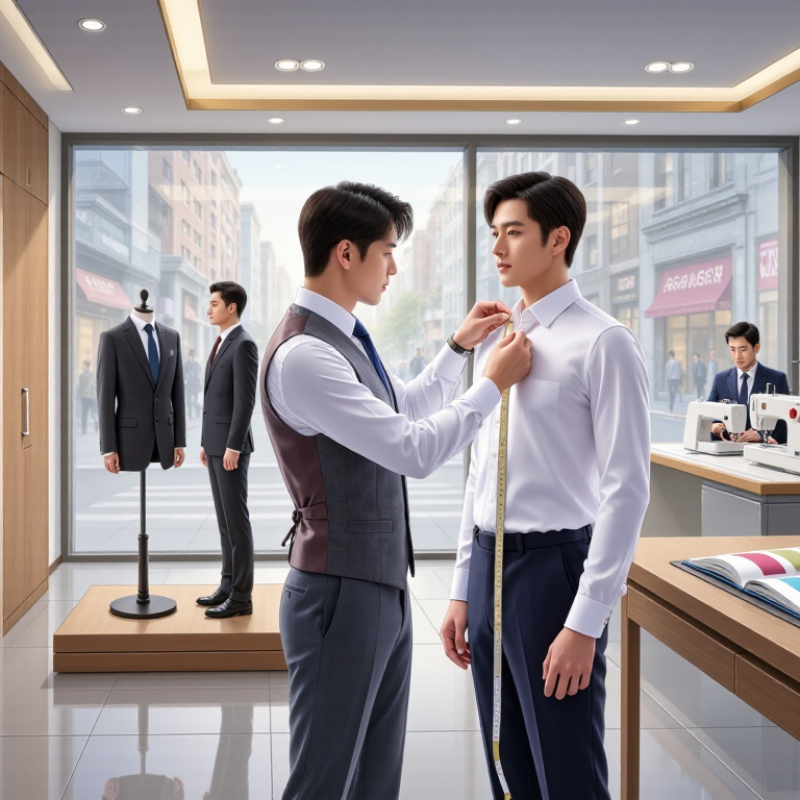
Definition and Scope of China's Made-to-Measure Fashion Industry
China’s made-to-measure fashion industry covers clothing produced from a standard pattern and adjusted to an individual customer’s measurements and preferences. A customer may choose sleeve length, waist ease, fabric, lining, or button placement. The garment is more personalized than standard ready-to-wear, but it does not necessarily begin with a wholly individual pattern. It is not fully bespoke.
In China, the category can include suits, shirts, dresses, coats, and other garments ordered through physical stores or online services. The process may involve an in-person fitting, measurements entered by a trained tailor, or digital tools that estimate body dimensions. These methods are not interchangeable. A small measurement error can change how a jacket sits across the shoulders or how trousers break at the shoe. The industry also spans design, fabric sourcing, pattern adjustment, production, fitting, and alterations.
China’s large apparel manufacturing base supports varied production models, but made-to-measure is not simply another name for factory-made clothing. Service quality and available options can differ by city, workshop, garment type, and customer expectations. Definitions also vary, which makes market comparisons difficult. I would treat online measurement claims cautiously: convenience is real, yet posture, fit preference, and fabric behavior remain hard to capture on a screen. A second fitting may still matter.
China Top Made to Measure Fashion Industry Analysis - Definition and Scope of China's Made-to-Measure Fashion Industry
| Industry Dimension | Definition and Scope | Industry Characteristics and Boundaries |
|---|---|---|
| Core definition | Made-to-measure (MTM) fashion refers to garments produced for an individual customer using personal measurements and selected design or fit options. | The garment is made after customer specifications are collected. Production may adapt an existing pattern or base block; MTM does not necessarily involve drafting a unique pattern from scratch. |
| Distinction from bespoke | MTM is distinct from bespoke tailoring, although terminology can vary across businesses and markets. | Bespoke work typically involves more extensive individual pattern development and fittings. MTM generally uses a standardized production framework adjusted to a customer's measurements and preferences. |
| Distinction from ready-to-wear | Ready-to-wear (RTW) garments are manufactured in standard size ranges for sale as finished products; MTM garments are configured or adjusted for an individual order. | A standard-size garment altered after purchase is not automatically an MTM product. The defining feature is the use of customer-specific specifications in the order and production process. |
| Products covered | The scope can include suits, jackets, trousers, shirts, coats, dresses, uniforms, and other apparel made to customer measurements or selected fit specifications. | Product coverage differs by service provider. Formalwear and business clothing are common MTM categories, while some services also offer casualwear or occasionwear. |
| Customer measurements | Measurement inputs may be taken in person, entered by the customer, or collected through a digital fitting process. | Measurement methods and accuracy controls vary. In-person measuring can include posture and fit assessment; digital methods depend on the measurement data and tools available. |
| Customization options | Customers may select fabric, color, garment details, and fit preferences, subject to the service's available options. | Customization ranges from measurement adjustments within a fixed design system to broader choices of construction and styling. The term MTM alone does not guarantee unlimited customization. |
| Order-to-delivery process | A typical process includes consultation or configuration, measurement collection, order confirmation, garment production, quality checks, delivery, and possible fit adjustments. | The sequence, number of fittings, delivery time, and alteration policy are service-specific. MTM usually requires more order-level coordination than purchasing an in-stock RTW garment. |
| Production model | Production is commonly triggered by an individual order and combines standardized processes with customer-specific measurements or options. | Work may be performed in dedicated tailoring facilities or integrated garment-production operations. The extent of automation, batch production, and manual finishing varies. |
| Sales and service channels | MTM services may be offered through physical fitting locations, appointment-based services, online ordering, or combinations of offline and digital touchpoints. | Channel choice affects how measurements, fabric selection, consultations, and after-sales adjustments are handled. Online availability does not by itself indicate a fully automated process. |
| Value chain | The industry value chain can include fabric and trim sourcing, measurement and style consultation, order management, pattern or fit adjustment, cutting, sewing, finishing, logistics, and after-sales service. | Activities may be performed by different organizations or coordinated within one service operation. This scope focuses on the MTM apparel service and production system rather than the entire textile industry. |
| Geographic scope | China's MTM industry can be considered across domestic customer services and garment production conducted in China for domestic or overseas orders. | The market boundary depends on the analysis: a domestic-market study tracks services sold to customers in China, while a production-focused study may also include export-oriented manufacturing. |
| Out-of-scope activities | Standard-size RTW production, resale of finished apparel, and standalone clothing repair or alteration are generally outside the core MTM definition. | These activities may support or overlap with MTM services, but they are not included unless the analysis explicitly defines a broader custom-apparel market. |
Scope note: Made-to-measure terminology and service features are not fully uniform across providers. The distinctions above describe common industry usage rather than a single universal legal classification.
FAQS
It starts with a standard pattern, then adjusts details to one customer’s measurements and preferences. It is personalized, but not fully bespoke.
Options may include suits, shirts, dresses, coats, and other garments. Customers can often choose fabric, lining, sleeve length, or button placement.
A tailor may measure in person, or digital tools may estimate body dimensions. These methods are not interchangeable.
A small measurement error can shift a shoulder seam or change how trousers fall over shoes. A fitting can reveal what a screen misses.
No. Posture, preferred roominess, and fabric drape are difficult to capture digitally. Convenience helps, but it has limits.
Ask about alteration policies, delivery timing, fabric quality, and how measurements are reviewed. Clear answers matter.
No. Some people prefer sharp lines, while others want room to move. The right fit depends on comfort and personal taste.
It can differ by city, workshop, garment, and staff experience. I would still be cautious about broad claims; definitions vary too.
Conclusion
Made-to-measure fashion refers to clothing created or adjusted for an individual’s measurements, preferences, and fit requirements. This Made-to-measure fashion industry analysis examines the scope of the sector in China, from its development and market growth to the structure of its supply chain and the roles of tailoring businesses, manufacturers, and retail channels. It also considers how changing lifestyles and greater interest in personal fit have shaped consumer demand.
The analysis explores customization processes, including measurement, design selection, fitting, and garment production, as well as the technologies that can support these steps. It considers different consumer segments and their expectations for fit, service, price, and delivery. Finally, it reviews emerging market trends and key challenges, such as production efficiency, consistent quality, skilled labor, and competition. Together, these factors help explain how businesses can adapt their offerings and build a sustainable position in China’s evolving made-to-measure fashion market.
